If you’ve landed on this page wondering what biological group your pet turtle actually belongs to, or you’re a student trying to make sense of the taxonomic tree, here’s our plain-English tour of the order Testudines — the only living reptiles with a true shell. We’ll work top-down: from order to suborder to family, with the well-known pet species flagged at each level so you can see where yours fits.
Tom put the original version of this page together in 2020 as a one-screen reference. The version you’re reading now is the expanded one we get the most use out of in the office — the version we copy-paste into reader emails when someone asks “is a tortoise a turtle?”
Quick answer: tortoise vs turtle vs terrapin
Everything with a shell is a turtle in the broad scientific sense. “Tortoise” is the everyday word for land-dwelling turtles in the family Testudinidae. “Terrapin” is British English for freshwater turtles, usually small ones — it’s a colloquial term rather than a taxonomic one. So:
- Every tortoise is a turtle — specifically, a land-living turtle in the family Testudinidae.
- A sea turtle is a turtle in the family Cheloniidae (most species) or Dermochelyidae (leatherbacks).
- A terrapin is, in casual British/Australian usage, a freshwater pond turtle — usually in family Emydidae.
That’s the answer to about a third of the “is this a turtle?” emails we get. The rest of this page is the proper taxonomy.
The order Testudines
Testudines is the reptile order containing every shelled species alive today. Roughly 360 species are currently recognised, spread across 14 living families. The defining feature of the group is the shell itself — specifically, a carapace (upper shell) and plastron (lower shell) fused to the spine and ribs. No other living reptile has anything like it.
Shelled reptiles have been around for at least 220 million years — older than most dinosaur lineages — and the basic body plan has changed remarkably little. The fossil record shows recognisable turtles before the K-Pg extinction event, after it, and continuously through to the present.
Two suborders: how they tuck their heads
The first major split inside Testudines is based on how the animal retracts its head into its shell. There are only two ways to do it, and turtles use one or the other.
Cryptodira — the “hidden-neck” turtles
Cryptodira (literally “hidden necks”) pull their heads straight back into the shell by bending the neck vertically, in an S-curve. This is the group most northern-hemisphere keepers will be familiar with — sliders, painteds, sea turtles, all the tortoises, all the snappers. About 75 % of living turtle species are Cryptodira.
The major families inside Cryptodira:
- Chelydridae — snapping turtles. Two North American genera, including the common snapper and the alligator snapper.
- Emydidae — pond turtles and box turtles. Sliders, painted turtles, map turtles, cooters, the North American box turtles. The single largest family in the pet trade.
- Geoemydidae — the Eurasian pond and box turtles. Reeves turtles, Asian box turtles, wood turtles.
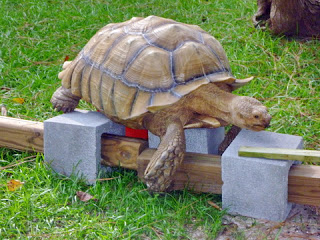
- Testudinidae — the true tortoises. Sulcatas, Hermann’s, Greek, Russian, red-foot, yellow-foot, Galapagos — if it’s a land-dwelling shelled reptile, it’s in this family.
- Kinosternidae — mud and musk turtles. Small, hardy, popular with small-tank keepers.
- Trionychidae — softshell turtles. Flat, leathery shells, long necks, specialised for ambush in soft river-bottoms. Florida softshells, spiny softshells, the giant Asiatic softshell.
- Cheloniidae — the hard-shelled sea turtles. Green, hawksbill, loggerhead, Kemp’s ridley, olive ridley, flatback.
- Dermochelyidae — the leatherback sea turtle. One living species, in its own family, with a leathery rather than bony carapace.
- Carettochelyidae — the pig-nosed turtle. One living species, restricted to northern Australia and New Guinea, structurally bizarre.
- Dermatemydidae — the Central American river turtle. One living species, critically endangered.
Pleurodira — the “side-neck” turtles
Pleurodira (“side necks”) retract their heads sideways, tucking them under the lip of the shell rather than pulling them straight in. They’re restricted to the southern hemisphere — South America, sub-Saharan Africa, Madagascar, Australia and New Guinea — and account for the remaining 25 % of living species.
The major families:
- Chelidae — the Austro-American sidenecks. Mata mata, snake-necked turtles, the Australian long-necked turtles. The mata mata (Chelus fimbriata) is in this family.
- Pelomedusidae — the African mud turtles and helmeted turtles.
- Podocnemididae — the South American river turtles, including the arrau (Podocnemis expansa), one of the largest freshwater turtles in the world.
How shell anatomy varies across the order
You can guess a lot about a turtle’s lifestyle from the shape of its shell.
- Domed, heavy shell — almost always a tortoise. Slow-moving, terrestrial, defensive against predators it can’t outrun.
- Streamlined, slightly flattened — freshwater swimmer. Most Emydidae fall here.
- Very flat, hydrodynamic, paddle-shaped limbs — sea turtle. The shell is reduced in mass to keep them buoyant and fast.
- Pancake-flat, leathery — softshell. Ambush predator that buries in sand or silt.
- Heavily ridged, with three keels along the carapace — often a map turtle or a snapper.
Where do popular pet species fit?
Here are the species most likely to be sitting in a reader’s tank, with their full taxonomic placement:
- Red-eared slider (Trachemys scripta elegans) — Cryptodira, Emydidae.
- Eastern painted turtle (Chrysemys picta picta) — Cryptodira, Emydidae.
- Common musk turtle (Sternotherus odoratus) — Cryptodira, Kinosternidae.
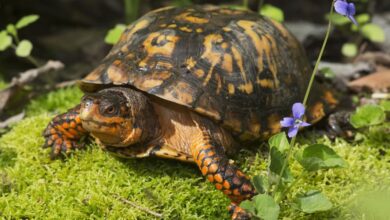
- Eastern box turtle (Terrapene carolina) — Cryptodira, Emydidae.
- Hermann’s tortoise (Testudo hermanni) — Cryptodira, Testudinidae.
- Sulcata tortoise (Centrochelys sulcata) — Cryptodira, Testudinidae.
- Florida softshell (Apalone ferox) — Cryptodira, Trionychidae.
- Mata mata (Chelus fimbriata) — Pleurodira, Chelidae.
- Reeves turtle (Mauremys reevesii) — Cryptodira, Geoemydidae.
Notice that almost every pet turtle in the western trade is a Cryptodira. That’s partly biogeography (most pet keepers live in the northern hemisphere) and partly history — the species best-suited to captivity tend to be the temperate Emydidae and Testudinidae.
Why this matters for your husbandry
Taxonomic relatives usually have similar care needs. If you know your turtle is in Emydidae, you can borrow husbandry from a related species when there isn’t a dedicated care sheet. If it’s a Pleurodira side-neck, expect quite different behaviour and tank layout. And if it’s a Testudinidae tortoise, the entire conversation shifts from “swimming pool” to “outdoor pen with weeds.”
Our species-specific guides at Turtle & Tortoise Breeds are organised by these family groupings rather than alphabetically, for exactly that reason. For practical husbandry, see our turtle & tortoise care index. For species ID help, our turtle identification archive has reader photos with answers.
Further reading
For the up-to-date checklist of recognised species (it changes yearly as DNA studies split or lump species), the open-access IUCN Tortoise and Freshwater Turtle Specialist Group is the authoritative source. The IUCN Red List has conservation status entries for almost every species.
— Tom, Turtle Times. Spotted an outdated family-level placement — or know of a recent split we’ve missed? Let us know via the Contact page and we’ll update this page.
Recent taxonomic changes worth knowing
If you read older field guides you’ll see family groupings that have since been revised. A few that have changed in the last 20 years and that come up in our reader emails:
- Bataguridae was the older name for what is now Geoemydidae. Asian box turtles, leaf turtles and Reeves turtles all moved with the rename.
- The genus Pseudemys (cooters) has been split, merged, and re-split several times. Most current literature recognises seven species, but some older books group them all under Chrysemys.
- The red-eared slider is now usually written as Trachemys scripta elegans; older sources have it as Pseudemys scripta elegans.
- The Yangtze giant softshell (Rafetus swinhoei) was treated as a regional variant of a related species until DNA work in the 2000s confirmed it as one of the most endangered turtles on Earth — fewer than five known individuals at the time of writing.
The practical effect for keepers is small — care doesn’t change because the genus name shifts — but it’s useful when you’re cross-referencing an older book against a current species list.
How biologists tell the families apart
For our students-of-biology readers, the features taxonomists use to separate families inside Testudines are mostly skull and shell structure:
- How the neck retracts (already covered — Cryptodira vs Pleurodira).
- The presence or absence of nasal bones in the skull.
- The shape and articulation of the hyoid (the bone supporting the tongue).
- Whether scutes are fused at certain points or remain separate.
- The presence of a hinged plastron (box turtles, mud turtles — in two different families).
The hinged plastron is a great example of convergent evolution: North American box turtles (Emydidae) and several mud turtles (Kinosternidae) both evolved hinges independently, which is why they look superficially similar but sit in different families.
Got a question we haven’t answered?
The Turtle Times team answers reader questions every week. Drop us a note — Linda covers health, Priya handles softshells and side-necks, Tom takes aquatic species, Marcus covers tortoises, Jenna runs new-owner triage.
Ask the team → Browse the Q&A archive