The red-eared slider is the most-kept pet turtle on Earth, and we’ve seen more bad slider tanks than any other species in our inbox. Tom’s kept sliders for twelve years and has done the maths the hard way — outgrowing two undersized tanks before finally settling on a 400-litre setup that’s now seven years old. This guide is the version we should have read at the start.
If you’ve just bought a hatchling, the punchline is: the tank you need for a hatchling is the tank you’ll need for the adult. They grow fast, and upgrading a tank halfway through is a real expense in money, water and stress on the animal.
How big does the tank actually need to be?
The rule we use is 10 US gallons (about 38 litres) of swim space per 2.5 cm (1 inch) of adult shell length. “Swim space” means actual water volume the turtle can use, not the tank’s total capacity — subtract the gravel, decor, basking platform, and the air gap at the top.
For an adult red-eared slider, that means:
- Male: matures at around 20–25 cm of shell length. Needs at least 100–120 US gallons (380–450 litres) of swim space.
- Female: matures at 25–30 cm and occasionally larger. Needs 120–150 US gallons (450–570 litres) minimum.
You’ll see “turtle tank” recommendations as low as 55 gallons online. Those are recommendations for a juvenile under 15 cm. They will not work for a fully grown slider.
If a 400‑litre indoor tank isn’t feasible, two alternatives that work:
- Stock tank or large plastic tub indoors — cheaper per litre than glass, easier to clean, less aesthetic. We’ve seen 600-litre stock tanks work beautifully for two adult sliders.
- Outdoor pond if you live in a climate that doesn’t freeze through winter. The pond needs predator-proofing (mesh roof for raccoons, herons, foxes), depth (60 cm minimum), and a haul-out. Sliders thrive outdoors when the climate allows.
Water
Sliders are aquatic. They want deep water they can swim through, not a puddle.
- Water depth: at least twice the shell length, ideally three times. Adults want 30–45 cm of water.
- Water temperature: 24–27 °C for healthy adults. Hatchlings benefit from the warmer end (27 °C) for the first year. A submersible heater rated for your tank volume is non-negotiable.
- Water testing: we test ammonia and nitrate monthly. Sliders are far more tolerant of bad water than fish, but ammonia spikes are a major cause of eye and shell problems. If ammonia ever reads above 0.25 ppm, do a partial water change immediately.
- Tap water: let it stand 24 hours or use a dechlorinator. Chloramines (used in many municipal systems) don’t off-gas the way old-school chlorine does, so a proper dechlorinator is safer.
Filtration
This is where most slider setups fail. Sliders produce roughly 10× the waste of similar-mass fish. The filter rule of thumb: rate the filter for 2–3× your tank’s actual water volume.
For a 400-litre setup, that’s 800–1200 litres/hour of filtration. Practical options:
- Canister filter (Fluval FX4, Eheim Pro, Aquatop) — our preferred option. Quiet, easy to maintain, big media volume.
- Hang-on-back filter (Aquaclear 110, AquaClear 70 in series) — cheaper, easier to clean weekly, but holds less media.
- DIY sump — if you’re comfortable with aquariums, a sump under the tank is the gold standard. Lots of media space, easy maintenance.
Whatever you pick, clean the mechanical media every 2–4 weeks and never replace all the biological media at once — you’ll crash the cycle.
Basking
Sliders bask a lot. The platform has to get the turtle fully out of the water with no risk of it slipping back in.
- Platform size: at least 1.5× the turtle’s shell length on the short axis.
- Basking-spot temperature: 32–35 °C at the platform surface, measured with a digital probe (not the strip thermometer that came with the tank).
- Basking bulb: a 75 W or 100 W incandescent flood lamp, depending on platform-to-bulb distance. Halogen flood lamps work; ceramic heat emitters don’t emit visible light and sliders need both heat and a bright light to bask properly.
- Photoperiod: 10–12 hours on, 12–14 off. Use a timer; don’t leave it to memory.
UVB — the make-or-break of slider health
Without proper UVB exposure, sliders develop metabolic bone disease (MBD): soft shell, rubbery jaw, weak limbs, deformed scute growth. The damage from established MBD is largely permanent.
- Use a real reptile-grade UVB tube. Arcadia 10.0, Zoo Med ReptiSun 10.0, or equivalent. Compact CFL bulbs are not adequate. Sunlight through glass is not adequate (glass blocks the UVB wavelengths the turtle needs — see our reader-question post on UVB through glass).
- Distance: the UVB tube needs to be within 25–30 cm of the basking platform. UVB output falls off rapidly with distance.
- Replace every 12 months. The tube still emits visible light long after the UVB output has dropped below useful levels. Mark the install date on the tube with a marker.
- No glass or plastic between tube and turtle. Mesh screen is fine; solid plastic lids block UVB.
Substrate
This is the contentious one. There are two reasonable positions:
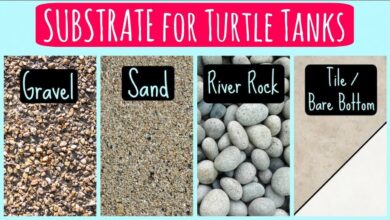
- Bare-bottom (our preference) — easier to clean, easier to spot uneaten food and waste, no risk of impaction. Aesthetic is a matter of taste.
- Large river rocks — visually nicer, harder to clean, no impaction risk because the rocks are too big to swallow.
What to avoid: small gravel (the slider will eat it and impact), aquarium sand (cleaning nightmare), bark chips (mold).
Decor and enrichment
Sliders aren’t especially playful, but they’ll use cover and enrichment when available:
- Driftwood — bogwood, malaysian driftwood. Sliders climb it and it tannins the water slightly (good for them).
- Smooth large rocks — stacked carefully to create overhangs.
- Live plants — anacharis, hornwort, anubias. Anubias is the only one most sliders won’t eat to the rhizome; the others they’ll snack on (which is fine).
- Fake plants — cheap, no maintenance. Watch for sharp edges.
What we’d avoid: heaters and filter intakes without guards (sliders chew cables and burn themselves on bare heating elements), sharp decorations, anything dyed (some craft-store rocks leach colour).
Cleaning and water-change schedule
Our schedule for a well-cycled 400-litre setup with a 1000 lph canister:
- Daily: remove uneaten food within 30 minutes of feeding. Sliders will eat to excess and the leftovers spoil fast.
- Weekly: 25–30 % water change. Siphon the bottom, top up with dechlorinated water at matching temperature.
- Monthly: clean filter mechanical media (rinse in old tank water, never tap), test ammonia + nitrate.
- Every 6 months: deep-clean basking platform, scrape any biofilm off rocks, replace UVB tube (annually, but check it twice a year).
Common mistakes we see in the inbox
- Tank too small — almost every health-problem email traces back to here. Upgrade before the turtle outgrows.
- No UVB or expired UVB — bulbs that haven’t been replaced in years. MBD waiting to happen.
- Basking spot too cool — if the turtle can’t reach 32 °C, it won’t bask properly, won’t metabolise food, and will get sick.
- No water filtration or under-filtered. Daily water changes are not sustainable.
- Diet too protein-heavy in adults — obese, fatty-liver sliders. We cover the right ratio in our Turtle Health & Feeding Guide.
- Glass-lid trapping heat and blocking UVB — use mesh, not glass.
Outdoor ponds — if you can swing it
If your climate allows (rough rule: where winter stays above 5 °C or the pond is deep enough for them to brumate underwater safely), sliders thrive outdoors. The setup:
- Pond depth: 90 cm minimum, ideally 1.2 m. The deeper end provides a frost-free brumation zone.
- Surface area: 3–5 m² for a single adult.
- Predator protection: heavy gauge mesh roof (raccoons can lift wire), buried fencing around the perimeter (to prevent foxes/badgers digging in).
- Basking area: a sloping log or platform that gets full sun for at least part of the day.
- Filtration: pond pump rated for your volume, ideally with a biological filter.
Outdoor sliders feed themselves on aquatic plants, insects and the occasional small fish, and you supplement with a couple of feedings a week. They get full-spectrum sunlight for free, which is far better than any artificial UVB tube.
Related on Turtle Times
- Red-eared Slider species overview — identification, lifespan, history.
- Turtle & Tortoise Care Sheets — enclosure hub for other species.
- Turtle Health & Feeding Guide — diet ratios + medical triage.
- Treating shell rot with Nolvasan — if the water-quality slip-ups catch up with you.
- Can I keep different species together? — relevant for community tanks.
— Tom, Turtle Times. Got a slider setup question or a photo of your tank for feedback? The contact form is the fastest route — tag “slider tank” in the subject.
Got a question we haven’t answered?
The Turtle Times team answers reader questions every week. Drop us a note — Linda covers health, Priya handles softshells and side-necks, Tom takes aquatic species, Marcus covers tortoises, Jenna runs new-owner triage.