Musk Turtle Tank Setup: The Small-Space Aquatic Pet

If you want an aquatic turtle but don’t have room for a 400-litre slider setup, the common musk turtle (Sternotherus odoratus) is one of the best-kept secrets in the hobby. Tom has kept musks in a 100-litre footprint for the past nine years and considers them the most underrated pet turtle for apartment-scale keepers. This is the setup guide we wish we’d had at the start.
The trade-offs are real: musks are smaller, less colourful and less social than sliders, and they don’t bask as obsessively. But they live 30+ years, stay healthy on simpler setups, and have personality once they settle in.
Why a musk turtle (and which species)
“Musk turtle” usually means the common musk turtle, also called the stinkpot — the species you’ll see in the US pet trade. There’s also the loggerhead musk (Sternotherus minor), razorback musk (Sternotherus carinatus) and flattened musk (Sternotherus depressus). Care is similar across the genus, with size and water-depth preferences being the main differences:
- Common musk (S. odoratus) — 9–13 cm of carapace at adult size. The most available and most forgiving.
- Razorback musk (S. carinatus) — 12–16 cm. Striking pronounced keel along the carapace. Loves stronger current.
- Loggerhead musk (S. minor) — 10–13 cm. Bigger head, more crustacean in its wild diet.
- Flattened musk (S. depressus) — the smallest at 7–11 cm. Endangered in the wild — ethical sourcing matters.
For a first-time keeper, the common musk is the right pick. The rest of this guide focuses on it, with notes where the others differ.
Tank size — smaller than you think
This is what gets people interested in musks. Where a slider needs 400 litres, a single adult common musk does well in:
- Minimum: 75 litres (20 US gallons) for an adult single male.
- Comfortable: 100–150 litres (30–40 US gallons) for an adult, more for a pair.
- Two adults: 200 litres minimum, and a male/female pair is the only combo that reliably coexists — two males will fight.
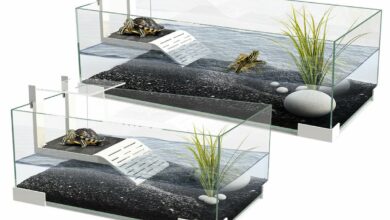
Footprint matters more than height. Musks are bottom-walkers, not swimmers; they’ll spend most of their day picking around the substrate looking for food. A long, low tank gives them more useful space than a tall narrow one.
Water
Common musks are unusual among aquatic turtles in that they don’t need deep water. They prefer to walk the bottom and surface for air rather than swim.
- Water depth: 20–30 cm for an adult. Deeper than the turtle’s length is fine if there’s structure (driftwood, rocks) for them to climb on; without structure, deeper water stresses them because they can’t easily reach the surface.
- Water temperature: 22–25 °C. The lower end is better for adults; hatchlings at 25 °C.
- Water quality: they tolerate slightly less clean water than sliders but you still want regular changes. Ammonia 0, nitrate under 40 ppm.
- Current: mild to moderate. Razorbacks want stronger flow; common musks are happy with the gentle current from a typical canister return.
Filtration
For a 100-litre musk setup, a filter rated 200–300 litres/hour is plenty. Options:
- Hang-on-back filter (AquaClear 50, Tetra Whisper) — cheap, easy to clean. Our preferred starter for small musk tanks.
- Small canister (Fluval 107, Eheim 2213) — quieter, holds more biological media, lasts longer between cleans.
- Sponge filter with air pump — perfectly fine for a single musk in a small tank. Adds gentle circulation without strong current.
Whatever you pick, ensure the intake is guarded — musks are small enough to get sucked against inlet grilles.
Basking setup
Musks don’t bask as much as sliders, but they still need a proper haul-out and UVB exposure. Many readers email saying their musk “never basks”; usually the basking platform is too high or the access too awkward.
- Platform height: just above the water surface, with a gradual ramp. Musks aren’t strong climbers.
- Basking temperature: 29–32 °C — cooler than sliders. A 50 W or 75 W bulb is usually enough for the smaller distance.
- UVB: still essential. A 5.0 reptile-grade tube replaced annually. Even though they bask less, the UVB they get during their brief warming sessions is what keeps their shell healthy.
- Underwater hide: just as important as the basking spot. A piece of bogwood with an overhang, or a fitted slate cave. Musks spend hours under cover.
Substrate and decor
Musks are foraging bottom-dwellers, and substrate choice matters more for them than for sliders.
- Bare-bottom — easiest to clean, fine for the turtle, less visually appealing. Our default for hatchlings.
- Fine pool-filter sand — mimics their natural habitat, lets them sift through. Use 2–3 cm deep. Vacuum thoroughly during water changes.
- Smooth large river rocks — aesthetic but creates dead spots where waste accumulates.
- What to avoid: small gravel (impaction risk), bark chips, anything sharp.
Decor for musks should focus on cover and walkable structure:
- Bogwood and malaysian driftwood — pieces that create overhangs and tunnels.
- Slate stacked into caves — secure the stack so it can’t fall on the turtle.
- Live plants — java fern and anubias survive musk attention; anacharis gets eaten.
Diet
Musks are more carnivorous than sliders, even as adults. Their wild diet is roughly 70 % animal protein lifelong (sliders shift towards 60 % plant as adults; musks don’t).
- Hatchlings: daily feedings of bloodworms, chopped earthworm, small shrimp, hatchling aquatic-turtle pellets.
- Juveniles to adults: every other day. Whole earthworms, small feeder fish (occasionally, parasite-free), shrimp, mussels, snails, aquatic-turtle pellets.
- Snails are gold — musks love them, the shells provide calcium, and they replicate the wild diet. Pond snails or trumpet snails from an aquarium shop are ideal.
- Plant matter: offer some greens (dandelion, anacharis, duckweed) but don’t expect them to take much. A few percent of total diet at most.
- Calcium dust: twice a week. Cuttlebone left in the tank as a free-choice option.
- Multivitamin: once a week.
Loggerhead musks have a stronger crushing jaw and will tackle bigger snails and small crayfish. Razorbacks eat more variety. Common musks are the omnivores of the group within the bias towards meat.
Behaviour and temperament
Three things to know about musk personality:
- They’ll bite. The common name “stinkpot” covers more than the musk gland. Common musks are notoriously willing to bite, especially when handled. Their jaws aren’t powerful enough to do real damage, but you’ll feel it. Don’t put fingers near the head.
- They’ll musk. Like snake-necked turtles, musks have musk glands at the rear of the carapace. Hatchlings and stressed adults release a foul secretion. Handling reduces over time but never goes to zero.
- They’ll surprise you with their climbing. Despite the short legs, musks are determined climbers. Our first musk escaped a tank with a 15 cm air gap because we’d underestimated her use of bogwood. Get a tank lid.
Common keeper mistakes
- Water too deep for hatchlings — hatchlings drown easily in deep water without structure. Start shallow, increase depth as they grow.
- No basking access — even though musks bask less, denying access leads to shell problems.
- Two males in one tank — never works long-term. They’ll fight, one will get injured.
- Feeding only pellets — musks need whole-prey nutrition. Pellets-only diets are linked to vitamin A deficiency and slow growth in this species more than in sliders.
- Glass-lid trapping humidity — use mesh, and ensure good airflow. Stagnant humid air over the basking area encourages fungal shell issues.
Tank-mates
The shorter answer is “no.” The longer answer:
- Other musks: only male/female pairs, and only with enough space. Two males will fight; two females can usually coexist but bullying happens.
- Other turtle species: not recommended. Musks bite at the tails and limbs of larger tank-mates.
- Fish: fast schooling fish (zebra danios, white cloud mountain minnows) can work in a large tank as living enrichment that the musk will occasionally try to catch. They’re fine if they outpace the turtle.
- Snails and shrimp: these are food, not tank-mates.
Outdoor option
Common musks can spend summer in an outdoor pond if your climate allows and the pond is properly predator-protected. They’re hardy down to about 5 °C water but should be brought indoors for the deep winter unless your pond has a frost-free brumation zone. Marcus runs his musk outdoors May to September in southern England with no issues.
Related on Turtle Times
- Musk Turtle species overview — identification and natural history.
- Care sheets and enclosures hub.
- Turtle Health & Feeding Guide — the diet companion.
- Master Care Index.
- Medical issues archive.
Further reading off-site
For musk-specific natural history, the Chelydra.org musk turtle pages are the longest-running keeper resource on the species. For UK keepers, the British Chelonia Group publishes the most detailed UK-applicable care research.
— Tom, who keeps three common musks named Pickle, Dent and Greta in a 200-litre tank. Got a setup question or a tank photo for feedback? Drop us a line — tag “musk turtle” in the subject.
Got a question we haven’t answered?
The Turtle Times team answers reader questions every week. Drop us a note — Linda covers health, Priya handles softshells and side-necks, Tom takes aquatic species, Marcus covers tortoises, Jenna runs new-owner triage.