Box turtles get their diet wrong more than any other commonly kept turtle. We see two patterns in our inbox over and over: keepers feeding only commercial pellets (cheap, convenient, terrible long-term) or feeding only lettuce and fruit (visually colourful, nutritionally hollow). The actual diet a healthy adult box turtle needs is more complex and more rewarding to get right. Marcus has kept Eastern box turtles for fourteen years; this is the diet plan we run and the one we send to readers when they email.
This guide focuses on the North American box turtles in the genus Terrapene — Eastern, Three-toed, Ornate, Gulf Coast and Florida. Asian box turtles (genus Cuora) are aquatic, not terrestrial, and have different dietary needs.
The big rule for box turtles: variety and live prey
Wild box turtles are opportunistic foragers. They’ll eat insects, slugs, snails, worms, mushrooms, berries, leafy plants, carrion, the occasional small reptile or amphibian. The single most important word in box turtle nutrition is variety. A turtle eating the same five foods for two years will develop deficiencies you only notice once they’ve become serious.
The ratio we aim for in adult Eastern box turtles:
- 50 % animal protein — mostly invertebrates, with rare whole-prey.
- 30 % vegetables and greens.
- 15 % fruit — more than you’d give a tortoise, less than a sweet-tooth keeper would assume.
- 5 % mushrooms.
Ornate box turtles tilt slightly more carnivorous (60 % protein, less fruit) reflecting their drier-prairie origin. Florida box turtles tilt slightly more herbivorous. The Eastern ratios above work well as a default.
Animal protein — the foundation
Best invertebrates
- Earthworms — nightcrawlers, red wrigglers, the occasional pre-killed jumbo. Whole-prey nutrition, calcium ratio close to ideal. The single best protein for box turtles. Feed 2–3 times a week.
- Slugs and snails — collected from a pesticide-free garden, or pond snails from an aquarium shop. Calcium-positive (shell + slime) and well-loved.
- Crickets and roaches — gut-loaded with leafy greens for 24 hours before feeding. Dust with calcium. Live insects matter for box turtles — movement triggers feeding response.
- Mealworms — occasionally, not as a staple. Hard exoskeleton, suboptimal calcium-to-phosphorus ratio.
- Waxworms — treat only. Too fatty.
- Silkworms and hornworms — excellent when available. High calcium, soft.
Occasional protein
- Pinky mice — once a month for adults. Whole-prey, calcium-good. Not for hatchlings (too rich).
- Hard-boiled egg — a small piece once a fortnight. Easy nutrition for picky eaters.
- Cooked, plain chicken or turkey — rare treat. Lacks calcium so don’t make it regular.
- Canned dog or cat food — older books recommend this; we don’t. The salt and protein concentrations are wrong for chelonians.
Commercial pellets
Mazuri Tortoise Diet (high fibre) or a good box-turtle-specific pellet can form 10–20 % of the diet as a nutritional safety net. They’re not a substitute for variety, but they fill in trace nutrients on weeks where you’re short on time to source live food.
Vegetables and greens
Daily-rotation greens
- Collard greens — high calcium, low oxalate.
- Dandelion greens (wild from a pesticide-free area, or supermarket).
- Mustard greens, turnip greens — bitter but well-tolerated.
- Endive, escarole — nutritious, mild flavour.
- Romaine — OK as a base, but never the only green.
Vegetables to mix in
- Squash and pumpkin — raw, grated. Box turtles love it. High in vitamin A.
- Sweet potato — cooked or raw grated. Once a week.
- Bell pepper — red and yellow; the carotenoids brighten the shell.
- Carrot — grated, occasional. The orange colour appeals.
- Green beans, peas — occasional.
- Broccoli — small amounts only. Goitrogen issues at higher quantities.
Greens and vegetables to avoid
- Iceberg lettuce as a staple — almost no nutrition.
- Spinach, swiss chard, beet greens — oxalates bind calcium.
- Cabbage in quantity — goitrogens.
- Avocado — toxic to most reptiles.
- Onions, garlic, chives — the entire allium family.
- Rhubarb leaves — oxalic acid toxicity.
Fruit — more than a tortoise, less than you’d think
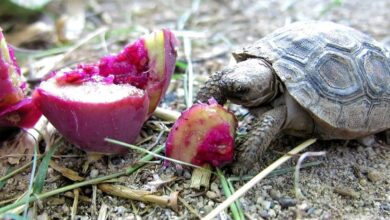
Box turtles handle fruit better than Mediterranean tortoises but worse than tropical tortoises. A fruit-heavy diet causes loose stools, vitamin imbalances, and selective eating (the turtle refuses anything that isn’t fruit).
Good fruit options
- Berries — blackberries, raspberries, blueberries, strawberries. Box turtles will hunt them down in the wild.
- Melon — cantaloupe, watermelon. The orange-flesh varieties have useful vitamin A.
- Mango, papaya — tropical fruits, very high in vitamin A. Box turtle favourites.
- Banana — occasional, small piece.
- Tomato — ripe only, small amounts. Skip green parts.
- Apple, pear — finely chopped, occasional.
Fruit to skip
- Citrus — too acidic.
- Grape — possible nephrotoxicity in some reptiles; avoid.
- Avocado — same as for the greens section.
Mushrooms — the box turtle superfood
This is the box-turtle-specific quirk most keepers miss. Box turtles in the wild eat a remarkable quantity of mushrooms — including species that are toxic to humans. Box turtle physiology handles certain mushroom toxins that would put a human in the hospital.
You don’t need to chase down wild fungi. Supermarket button mushrooms, oyster mushrooms, shiitake and portobello are all fine to offer once or twice a week. Box turtles tend to love them; the texture and protein profile mimic their wild diet.
Don’t feed wild-collected mushrooms unless you’re a mycologist; some species are toxic even to box turtles. Stick to cultivated.
Supplements
- Calcium powder without D3 — dust two or three meals a week. Especially important for hatchlings and breeding females.
- Cuttlebone — leave a piece in the enclosure at all times. Box turtles self-regulate by gnawing it when they want more calcium.
- Multivitamin including vitamin A — once a week. Vitamin A deficiency is a leading cause of swollen eyes in box turtles, and dietary beta-carotene alone doesn’t cover them well.
If your box turtle gets unfiltered outdoor sunshine regularly, you don’t need calcium-with-D3. For indoor-only animals with a UVB tube, calcium-without-D3 is fine because the UVB drives D3 synthesis. Adding D3 supplement on top of either source is rarely useful and occasionally harmful.
Feeding logistics
- Feed in the morning after the turtle has warmed up. Cold turtles don’t digest.
- Hatchlings: daily, small portions.
- Juveniles (year 1–3): daily or every other day.
- Adults: 3–4 times a week. Box turtles in the wild fast naturally during cold or dry weeks — consistent daily feeding is over-feeding.
- Hydration: a shallow water dish big enough to soak in. Box turtles drink and soak; some won’t drink from a small dish.
- Soak weekly — 15–20 minutes in lukewarm water. Encourages drinking and bowel movement.
Common feeding mistakes
- All pellets or all lettuce — both lead to deficiency over months.
- Too much fruit — selective eating, runny stool, mineral imbalance.
- No live invertebrates — box turtles need movement-triggered feeding response. They also extract nutrients from whole prey differently than from chopped food.
- Feeding at the wrong temperature — a turtle below 22 °C won’t eat. Check ambient temperature before assuming illness.
- Skipping calcium — MBD develops quietly. Don’t miss your dustings.
- Forcing variety on a stubborn eater — if your turtle has settled into a narrow diet, broaden it gradually. Day one: add one new item alongside favourites. Don’t starve them into compliance — long fasts in box turtles can trigger anorexia.
Sample weekly meal plan
For an adult Eastern box turtle:
- Monday: 2 nightcrawlers + grated squash + dandelion greens. Calcium dust.
- Tuesday: Rest day (water + soak only). Wild box turtles fast routinely.
- Wednesday: 3 crickets gut-loaded + collard greens + a few blackberries. Multivitamin.
- Thursday: Rest day.
- Friday: Mushrooms (1 button mushroom chopped) + sweet potato + romaine. Calcium dust.
- Saturday: 2 garden snails (pesticide-free) + bell pepper + a small piece of melon.
- Sunday: Rest day, with a brief soak.
Adjust based on the turtle’s body condition and what’s in season. Wild-foraged dandelions in spring, late-summer berries from the garden, autumn windfall apples (sparingly) all rotate the diet naturally.
Hatchling diet differences
Box turtle hatchlings are almost entirely carnivorous for the first 6–12 months. Feed daily, small soft invertebrates (chopped earthworm, small crickets, mealworms with the head squeezed soft, soaked pellets). Offer plant matter alongside but don’t expect it to be eaten in quantity. The shift towards omnivory happens gradually through the second year.
Related on Turtle Times
- Box Turtles species overview — identification and natural history.
- Turtle Health & Feeding Guide — the master diet hub.
- Turtle & Tortoise Care Index.
- Vitamin A deficiency — the deficiency a bad box turtle diet usually causes first.
- All feeding posts.
Further reading off-site
The Tortoise Trust’s nutrition archive has the most rigorous open-access research on chelonian feeding. The Box Turtles species reference is a useful complementary resource on species-specific dietary tilts.
— Marcus, who’s kept a male Eastern box turtle named Rufus outdoors in a 4×3m pen since 2012. Got a box turtle diet question? Drop us a line — tag “box turtle diet” in the subject.
Got a question we haven’t answered?
The Turtle Times team answers reader questions every week. Drop us a note — Linda covers health, Priya handles softshells and side-necks, Tom takes aquatic species, Marcus covers tortoises, Jenna runs new-owner triage.