Softshell Turtle Tank Setup: Complete Care Guide

Softshell turtles are the weird ones — flat as a pancake, leathery instead of bony, with snorkel-like noses and the ability to bury themselves so completely in substrate that only the tip of the snout shows above the sand. Priya keeps a Florida softshell and a small spiny softshell, and they are her favourite turtles in the collection. Difficult, opinionated, beautiful.
This is the tank setup we’d run for a captive-bred softshell. They’re not beginner turtles — the substrate requirement alone disqualifies them as a first pet — but for keepers ready for the second or third species, they’re unmatched.
Species in the trade
Three species commonly available:
- Florida softshell (Apalone ferox) — the largest. Females reach 60 cm of shell length; males stay around 30 cm. Powerful, aggressive feeders, dramatic but high-maintenance.
- Spiny softshell (Apalone spinifera) — medium-sized. Females 35–45 cm, males 18–25 cm. The most popular pet softshell in the US.
- Smooth softshell (Apalone mutica) — smaller. Females 25–35 cm, males 15–20 cm. Less common in the trade.
Asian and African softshell species exist but are rarer and often have specific permit requirements.
Tank size
Softshells need horizontal space — they cover ground when active. The female-male size split also means tank planning matters from the start.
- Male spiny softshell: 280 litres (75 US gallons) minimum.
- Female spiny softshell: 500+ litres (130+ US gallons). Stock tank or outdoor pond territory.
- Female Florida softshell: outdoor pond. Indoor housing isn’t realistic.
- Hatchlings: 60–100 litres for the first year. Plan the upgrade.
Long footprint dramatically beats tall narrow. A 120 cm long × 50 cm wide tank suits softshells far better than a 90 cm cube of similar volume.
Substrate — the species-defining setup point
This is the rule: softshells need fine sand, at least 5 cm deep, across most of the tank floor. Without sand, the softshell can’t express its natural burrowing behaviour, and over time the lack of cover causes chronic stress.
- Use: pool-filter sand (large grain, doesn’t cloud water), play sand (cheaper but cloudier), or aragonite sand (calcium-rich but more expensive).
- Depth: 5–8 cm minimum, deeper at one end where the softshell will choose to burrow.
- Don’t use: gravel (will be ingested and impact), bare bottom (no burrowing, abrasion damage to plastron), or coarse aquarium sand (too rough).
Sand setups require disciplined cleaning. Siphon the surface weekly, stir the deeper layer monthly to release anaerobic pockets, and watch for cloudy water (usually means the sand has compacted too much).
Water
- Water depth: at least 2× shell length. Softshells are strong swimmers despite their shape and use the water column.
- Temperature: 24–28 °C adults; 26–28 °C hatchlings.
- Filtration: rated 3× tank volume minimum. Softshells are messy and the sand traps debris. Canister filters strongly preferred.
- Flow: moderate. Softshells appreciate some water movement (river dwellers in the wild) but not torrent.
- Water changes: 25 % weekly.
- pH: 6.5–7.5; soft water is fine.
Basking
Softshells do bask, but they’re extremely nervous baskers — the slightest disturbance sends them diving. The setup has to work:
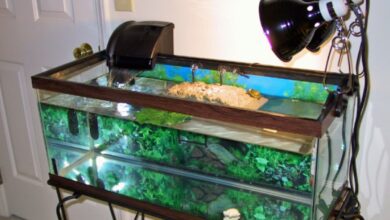
- Basking platform: a smooth-edged ramp at one end of the tank that allows them to climb partway out without leaving the water entirely. Some keepers use a sloping pile of sand that breaks the surface; others use a smooth river-rock cluster.
- Temperature target: 30–32 °C at the basking surface. Slightly cooler than sliders.
- UVB: reptile-grade 10.0 tube within 25 cm. Annual replacement.
- Position the tank in a low-traffic area — a kitchen-adjacent tank where people walk past every 10 minutes will never get used for basking.
Diet
Softshells are aggressive carnivores. Females in particular have powerful jaws and crush prey readily.
- Hatchlings (daily): bloodworms, chopped earthworm, small krill, hatchling pellets. Live food is taken more readily than frozen.
- Juveniles (every other day): earthworms, crickets (gut-loaded), krill, mussel, hatchling-sized feeder fish (gut-loaded, parasite-free), pellets as half the protein.
- Adults (every 2–3 days): whole nightcrawlers, raw shrimp, mussels, the occasional pinky mouse (treat, monthly), crayfish (for larger softshells), pellets.
Plant matter is largely irrelevant. Softshells will occasionally take soft aquatic plants but it’s never a meaningful part of the diet.
Calcium dust food twice a week, multivitamin weekly with retinol (vitamin A as retinol, not just beta-carotene). Calcium-rich whole foods — small snails, krill with shells — help significantly.
Behaviour and handling — the bite warning
Adult female softshells — particularly Florida softshells — can deliver a serious bite. Their jaws are powerful enough to take off a fingertip. The long neck means they can reach much further than you’d expect; assume a 30 cm softshell can strike at half a metre.
Practical handling rules:
- Never put hands in the tank during feeding.
- Use a long-handled net for tank moves; don’t lift by hand if you can avoid it.
- Hold by the rear of the shell, never by the head end. Even small softshells will whip their head around.
- Cleaning the tank: move the softshell to a holding tub first (water transfer with a net), don’t try to clean around it.
Health red flags
- Skin or shell fungus — softshells are especially prone because their leathery skin doesn’t shed scutes. Look for fuzzy white patches; treat with daily dry-docking and topical iodine wash.
- Shell pitting or soft patches — shell rot, usually water-quality related.
- Respiratory infection — lopsided floating, open-mouth breathing. Common in under-heated setups.
- Refusal to bury — usually means the sand is wrong type (too coarse), too shallow, or the tank is in too high-traffic a position.
- Plastron abrasion — usually from sliding on a bare-bottom tank. Add sand, and the abrasions heal.
Full triage in our Turtle Health & Feeding Guide.
Lifespan
Captive softshells regularly live 30–50 years. Wild-caught animals shorter; captive-bred from a good breeder do best.
Outdoor housing — for adult Florida softshells, essentially required
Adult female Florida softshells in indoor tanks are a chronic compromise. Outdoor ponds in warm climates are the better answer:
- Pond depth: 1 m minimum.
- Surface area: 8–15 m² for a single adult Florida.
- Sandy bottom: at least 10 cm of sand layer.
- Predator mesh roof and buried perimeter fencing.
- Basking log or rock at the surface.
Buying advice
- Captive-bred only. Wild-caught softshells are common and often arrive injured (their leathery shells damage easily during shipping). Hatchling prices US$40–150 depending on species.
- Check the shell. Soft pliable leather is normal — that’s the species. But look for unusual patches, fungus, or pitting.
- Watch it swim. Active swimming is a good sign. Healthy softshells move with surprising agility.
- Ask which species and sex. A female Florida softshell hatchling looks identical to a male; the eventual size difference is enormous.
Related on Turtle Times
- Softshell Turtle species overview — natural history and identification.
- Softshell turtle egg incubation — if you find or breed eggs.
- Care Sheets & Information — enclosure hub.
- Turtle Health & Feeding Guide — diet and medical companion.
- Turtle & Tortoise Care Index — master husbandry hub.
— Priya, Turtle Times. Got a softshell setup question or trying to identify your animal? The contact form reaches my inbox — flag “softshell” in the subject.
Got a question we haven’t answered?
The Turtle Times team answers reader questions every week. Drop us a note — Linda covers health, Priya handles softshells and side-necks, Tom takes aquatic species, Marcus covers tortoises, Jenna runs new-owner triage.
Ask the team → Browse the Q&A archive