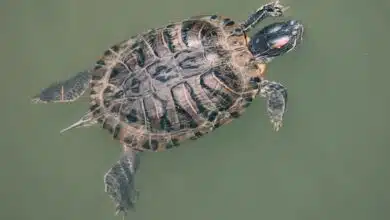
Snapping turtles are the species we’re most cautious about recommending. They’re long-lived, they grow enormous, they can deliver a serious bite, and they’re fundamentally not handling pets. They’re also misunderstood — the “will bite your finger off” reputation is overblown, but the “easy beginner pet” counter-claim is just as wrong. Marcus has kept a common snapping turtle for eleven years and has views.
This guide is for the keeper who’s already decided on a snapper and wants to know how to do it properly. If you’re still deciding, the most-honest summary we can give: get a slider or a cooter instead unless you have outdoor pond space and you specifically want a snapping turtle.
Species
Two species commonly kept:
- Common snapping turtle (Chelydra serpentina) — the standard. Native to North and Central America. Adults reach 25–47 cm of shell length and 5–20 kg.
- Alligator snapping turtle (Macrochelys temminckii) — the giant. South-eastern US. Adults reach 60–80 cm and 30–100 kg. Protected in many states; permit-only.
This guide focuses on the common snapper — the alligator snapper is essentially a different animal in terms of housing needs (and in most jurisdictions, permit requirements).
Adult size — the part most new keepers underestimate
Hatchling common snappers are 3 cm of shell length and look adorable. Adults reach 25–47 cm of shell, weigh 5–20 kg, and need a pond or outdoor enclosure rather than any indoor tank. This is the single biggest reason we caution against snapping turtles as pets — nobody warned the keeper at the pet shop about adult size.
If you bought a hatchling and now have a 20 cm juvenile pushing the limits of a 200-litre tank, you have roughly two years before the housing becomes inadequate. Outdoor pond, or rehome.
Tank or pond size
- Hatchlings (under 8 cm shell): 100 litres works for the first year. Single only — snappers are aggressive even as babies.
- Juveniles (8–15 cm shell): 300 litres. Stock tank rather than glass aquarium — cheaper and more practical.
- Sub-adults (15–25 cm): 500+ litres or outdoor.
- Adults: outdoor pond. 4×4 m surface area, 1 m depth, predator-proof. Anything less is welfare-borderline.
Snappers don’t use water depth the way sliders do — they walk along the bottom and surface for air. So pond depth matters more for brumation (where supported by climate) than for swim space. A shallow pond with adequate surface area beats a deep narrow pond.
Water and filtration
- Temperature: 22–26 °C adults. Snappers tolerate cooler temperatures than sliders — they brumate naturally underwater in winter across most of their range.
- Filtration: heavy. Adult snappers produce extraordinary volumes of waste. Plan filtration capacity for 3–4× tank volume.
- Water depth: for indoor housing, 30–50 cm is fine. They’re bottom-dwellers.
- Water changes: weekly minimum.
Basking
Adult common snappers don’t bask much. Juveniles bask more readily. The setup:
- Platform or log breaking the surface — many adult snappers rarely use it but it should be available.
- UVB tube — even if they don’t bask, providing UVB matters for shell health. Reptile-grade 5.0 or 10.0 within range of any accessible surface.
- Basking lamp for juveniles; less critical for adults that don’t use the platform.
Adult outdoor pond keepers get sunlight for free; this is one reason outdoor housing works so well for the species.
Substrate
Bare-bottom for indoor tanks (easy to clean, important given the waste volume), sandy or gravelly natural substrate for outdoor ponds. Snappers don’t bury themselves; substrate is for the aesthetics and biological filtration rather than the turtle’s behaviour.
Diet — voracious omnivores
Snappers will eat almost anything. The challenge is feeding them a balanced diet rather than just protein.
- Hatchlings (every other day): earthworms, krill, hatchling pellets, the occasional small feeder fish.
- Juveniles (every 2–3 days): earthworms, mussels, raw shrimp, small fish, pellets, leafy greens (most will eat them once they learn).
- Adults (twice a week): larger items — whole prey fish, mussels, the occasional pinky mouse, smelt, aquatic vegetation. Outdoor pond adults supplement with whatever wanders in.
Adult snappers in the wild are 60–80 % carnivorous but eat substantial plant matter. The reputation as “pure predators” is wrong. Feed plant matter; they’ll eat it.
Calcium supplementation twice a week, multivitamin weekly.
Don’t overfeed adults. Sedentary captive snappers get obese readily and fatty-liver disease is the long-term consequence.
Behaviour and handling
This is the part to take seriously. Adult snappers can deliver a serious bite. The neck is long and the strike is fast.
- Never handle by hand. Use a long-handled net for transfers; if you must lift, do it by the rear half of the shell with both hands, head pointing away.
- Never put fingers near the head end. Snapper strikes can reach behind the neck and around the side of the shell.
- The “hold by the tail” advice is wrong. It damages the spine. Use the shell.
- Pond keepers: if a snapper escapes the enclosure or you find one wild, leave it alone. Call a wildlife rehabber.
- Children should not interact with the tank.
The bite reputation is real but contextually overblown. Wild snappers on land are defensive (because they can’t retreat into water) and bite readily. Wild snappers in water mostly swim away. Captive snappers in their established tank are usually calm. The bite happens when you handle them or surprise them, not because they’re aggressive in general.
Brumation
Wild snappers brumate underwater through winter across their northern range. Outdoor pond keepers in temperate climates let them brumate naturally — they surface occasionally through ice holes to breathe (snappers can absorb some oxygen through cloacal tissue while brumating, which is unusual).
Indoor captive snappers at year-round warm temperatures don’t need to brumate to stay healthy. Brumation is required for breeding.
Lifespan
Common snappers regularly reach 30–50 years in captivity; some specimens have passed 60. Wild snappers are believed to live similar spans. This is a serious long-term commitment — you’re likely to outlive most relationships before you outlive the snapper.
Legal status
Common snappers are protected in some US states (notably much of New England) and require permits. Alligator snappers are protected federally and in every state where they occur. Internationally, snapping turtles are protected in many jurisdictions — the UK requires DEFRA approval to keep Chelydra, for example. Check before you buy.
Buying advice
- Captive-bred only. Hatchling prices US$30–100 for common, much higher for alligator snappers where legally available.
- Plan for adult housing before buying. A hatchling snapper is a 10-year commitment to a 5,000-litre pond. If that’s not realistic, choose a different species.
- Don’t adopt or take in wild snappers. They’re protected in many places and adapt poorly to captivity.
Related on Turtle Times
- Snapping Turtle species overview — natural history and identification.
- Care Sheets & Information — enclosure hub.
- Turtle Health & Feeding Guide — diet and medical companion.
- Turtle & Tortoise Care Index — master husbandry hub.
- Medical issues archive — shell rot, MBD, respiratory infections.
— Marcus, Turtle Times. Got a snapper question — including the “I bought a hatchling and didn’t realise what I was getting into” situation? The contact form reaches my inbox — flag “snapper” in the subject.
Got a question we haven’t answered?
The Turtle Times team answers reader questions every week. Drop us a note — Linda covers health, Priya handles softshells and side-necks, Tom takes aquatic species, Marcus covers tortoises, Jenna runs new-owner triage.