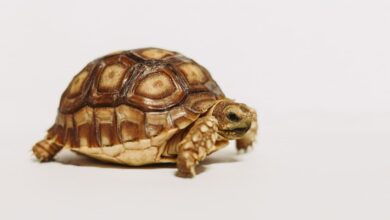
Russian tortoises (Testudo horsfieldii, also called Horsfield’s tortoise) are the smallest of the commonly-kept Testudo species and the species we recommend for keepers who want a tortoise but have limited outdoor space. Marcus has kept a single male Russian named Boris in an outdoor pen for nine years — he’s a fraction of the size of a Sulcata, hardier than a Hermann’s, and the most independent tortoise we’ve owned.
Species overview
Russian tortoises are native to the dry steppes and rocky hills of central Asia — Iran, Afghanistan, Pakistan, Kazakhstan, Uzbekistan and the southern fringes of Russia. The arid native climate shapes their care needs — they tolerate dryness better than any other commonly-kept tortoise and dislike high humidity.
Adult size:
- Males: 12–18 cm shell length, 500–900 g.
- Females: 15–20 cm shell length, 700 g–1.5 kg.
The smallest of the common Testudo species. Adult Russians fit in a modest outdoor pen that wouldn’t accommodate a Hermann’s, let alone a Sulcata.
Why we recommend them for small-space keepers
- Small adult size — a 2×1.5 m outdoor pen accommodates an adult Russian comfortably.
- Hardy — tolerates cooler temperatures and lower humidity than Hermann’s or Greeks. Adapted to harsh continental climate.
- Independent temperament — doesn’t demand interaction the way red-foots do.
- Long brumation tolerance — Russians naturally brumate for 5–6 months in the wild (longer than other Testudo). Captive brumation is straightforward.
- Active, observable — despite the “independent” label, they’re active foragers when conditions are right and pleasant to watch.
Outdoor pen
Minimum size for a single adult Russian:
- Footprint: 2×1.5 m. Larger is better but acceptable smaller than Hermann’s minimum.
- Walls: 30 cm above ground, buried 30 cm. Russians are diggers — this is the species-specific point. They’ll dig out if walls aren’t deep enough.
- Substrate: hard-packed loam with sand patches; minimal grass since wild Russians don’t graze on lush turf.
- Hide: wooden shelter or stone overhang in the cooler corner.
- Basking spot: south-facing flat stone.
- Burrow access: they dig their own. Provide a sandy or loose-soil patch.
- Shade: 30 % of the pen, important on hot summer days.
- Water: shallow dish, refreshed every other day. Russians drink less than other Testudo but still need access.
Russians don’t need the heavily-planted forage pen that Hermann’s thrive in. Sparse grass with a few weed patches matches their wild conditions better.
Indoor housing
Hatchlings indoors for the first 2 years; adults outdoors May-September with indoor or insulated-shed winter accommodation. Same indoor framework as Hermann’s:
- Tortoise table 120×60 cm for hatchlings, 200×80 cm for adults.
- Basking spot 32–35 °C; ambient cool end 18–22 °C.
- UVB tube replaced annually.
- Substrate: soil-and-sand mix, drier overall than Hermann’s setup.
- Multiple hides.
Brumation
Russians brumate longer than other Testudo — up to 5–6 months in the wild. Captive brumation typically runs 14–18 weeks. The protocol is the same as for Hermann’s; see our brumation guide for the full process.
One species-specific note: Russians tolerate slightly cooler brumation temperatures than other Testudo (down to 2–3 °C briefly) but the 4–8 °C target range is what we use.
Diet
Same Mediterranean framework as Hermann’s, with one adjustment: Russian tortoises in the wild eat tougher, drier forage than Hermann’s. Lean toward fibrous weeds rather than soft greens:
- Daily staples: dandelion, plantain (the weed), clover (occasional), sow thistle, mallow leaves.
- Less of: soft supermarket greens like romaine and rocket. Russians prefer tougher material.
- Edible flowers: hibiscus, dandelion flowers, nasturtium.
- Almost no fruit. Russians tolerate fruit less well than Hermann’s. Once a month at most, fingernail-sized portion.
- No protein supplements. Strict herbivore in captive setups.
Calcium dust twice a week, multivitamin weekly, cuttlebone free-choice. The standard Mediterranean approach (covered in Mediterranean Tortoise Diet) transfers directly.
Behaviour
Russians are diggers, escape artists, and methodical foragers. They’ll:
- Dig under inadequately-buried fences within days.
- Climb anything climbable — rocks, logs, garden furniture.
- Hide in dense vegetation; you’ll lose track of them in over-planted pens.
- Show strong individual personality differences — some bold and food-driven, others reclusive.
Pen security is the practical issue. Russians have escaped from gardens we’ve seen in Europe and never been found. Bury the perimeter and check it monthly.
Health red flags
Same as other Testudo; see our Turtle Health & Feeding Guide for full triage. Russian-specific issues:
- Bladder stones — more common in Russians than other Testudo, usually from chronic dehydration. Provide regular soaks.
- Respiratory infection — cool damp conditions trigger it. Russians need warmth + dryness, not warmth + humidity.
- Stress fractures or limb injuries — from climbing falls. Don’t stack rocks they can climb high.
Lifespan
Captive Russians regularly live 40–50 years. Wild specimens believed to reach 40+. Long-term commitment but slightly shorter than Hermann’s on average.
Legal status
Russian tortoises are CITES Appendix II — less restrictive than Hermann’s (which are Annex A in the EU/UK). Practical implications:
- No Article 10 certificate required for keeping or selling in the EU/UK.
- CITES paperwork required for international transfers.
- Significantly easier to buy and sell legally than Hermann’s.
This is one reason Russians have become popular in the US trade — cheaper paperwork than Mediterranean species.
Buying advice
- Captive-bred only. Wild-caught Russians are unfortunately still common in some markets and arrive stressed and parasite-laden.
- Hatchling prices: £80–200 in the UK, US$80–200 in the US. Cheaper than Hermann’s due to easier paperwork.
- Check the shell carefully. Wild-caught Russians often have shell damage from rough collection or shipping.
- Verify subspecies — sub-types exist. “Russian tortoise” in the trade can mean one of several subspecies. T. h. horsfieldii is the standard.
- Watch the animal. Active, alert, walks confidently, eats readily when offered.
Related on Turtle Times
- Mediterranean Tortoise Diet Guide — full diet framework.
- Care Sheets & Information — enclosure hub.
- Turtle Health & Feeding Guide — medical companion.
- Turtle & Tortoise Care Index — master husbandry hub.
- Turtle & Tortoise Breeds — species index for comparison.
— Marcus, Turtle Times. Russian tortoise question? Contact form — flag “Russian tortoise” in the subject.
Got a question we haven’t answered?
The Turtle Times team answers reader questions every week. Drop us a note — Linda covers health, Priya handles softshells and side-necks, Tom takes aquatic species, Marcus covers tortoises, Jenna runs new-owner triage.
Ask the team → Browse the Q&A archive