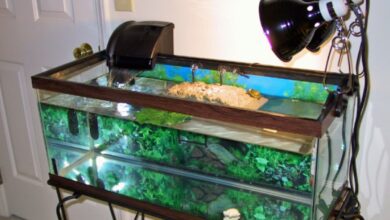
Painted Turtle Tank Setup: Complete Guide

Painted turtles are the second-most-kept aquatic turtle in the trade after red-eared sliders, and their tank setup is similar but with a few species-specific differences worth getting right. Tom keeps a Western painted (Chrysemys picta bellii) named Vincent in a 280-litre indoor tank and has spent eight years dialling in the setup. This is the version we’d hand to anyone planning a painted turtle build.
Tank size — the species-specific point
Painted turtles are smaller than sliders. The tank-size rule we use is the same 10 US gallons per 2.5 cm of shell length, but the resulting tanks are more manageable:
- Male painted: matures at 13–17 cm shell length. Needs 75–100 US gallons (280–380 litres) swim space.
- Female painted: matures at 15–25 cm. Needs 100–150 US gallons (380–570 litres).
The four subspecies vary in adult size:
- Western painted (C. p. bellii) — largest. Females reach 25 cm.
- Midland painted (C. p. marginata) — medium, 18–20 cm.
- Southern painted (C. p. dorsalis) — smallest, 13–15 cm.
- Eastern painted (C. p. picta) — medium, 15–18 cm.
Hatchlings of all subspecies look similar; size differences emerge over the first 3–4 years.
Water depth and parameters
- Water depth: at least 3× the turtle’s shell length. Painteds are strong swimmers and use the column. Adults want 30–45 cm of water.
- Water temperature: 22–25 °C for adults; 24–26 °C for hatchlings. Painteds tolerate cooler water than sliders — they brumate naturally across most of their range.
- pH: 6.5–7.5; not critical.
- Tap water: dechlorinate or stand 24 hours.
- Water testing: monthly ammonia and nitrate. Painteds tolerate water-quality slips less well than sliders — shell rot risk is higher.
Filtration
Painted turtles produce slightly less waste than sliders per body mass — but the difference is small. Plan for substantial filtration:
- Filter rated for 2× tank volume minimum. For a 280-litre tank, plan on 560 lph throughput.
- Canister filter preferred — quieter, easier to maintain, larger media volume than hang-on-back filters.
- Hang-on-back filters work for smaller setups; Aquaclear 70 or 110 are reliable.
- Maintenance: rinse mechanical media every 2–4 weeks in tank water (not tap). Never replace all biological media at once.
Basking
Painted turtles are heavy baskers — they’ll spend several hours daily on the platform in good conditions. The setup matters:
- Platform size: at least 1.5× shell length on the short axis.
- Basking temperature: 32–35 °C at the platform surface. Digital probe thermometer; don’t guess.
- Basking lamp: 75–100 W flood lamp depending on platform-to-bulb distance.
- UVB tube: reptile-grade T5 HO 10.0, within 25 cm of the platform. Annual replacement.
- Photoperiod: 10–12 hours summer, 8–10 winter.
- Mesh top: not glass, which blocks UVB.
Substrate
Two acceptable approaches:
- Bare-bottom (our preference) — easiest to clean, easier to spot waste and uneaten food.
- Large smooth river rocks — visually nicer, harder to clean. Rocks must be too big for the turtle to swallow.
Don’t use:
- Small gravel — painteds eat it and impact.
- Aquarium sand — cleaning nightmare; some sands can cause health issues.
- Coloured glass or marbles — choking and impaction risk.
Decor and live plants
Painted turtles will browse on live plants more than sliders — particularly anacharis and duckweed. Plan accordingly:
- Driftwood: bogwood pieces breaking the surface. Painteds climb them and the tannin staining is healthy.
- Smooth large rocks: stacked carefully to create overhangs and resting spots.
- Live plants: anacharis (will be eaten), anubias on driftwood (survives), java fern attached to wood, water lettuce floating, duckweed (will be eaten and reproduces).
- Fake plants: if live plants don’t suit. Watch for sharp edges.
- Underwater hides: caves, pipe sections, or rock overhangs. Painteds use cover when available.
Outdoor pond — the upgrade
Painted turtles thrive outdoors. In temperate climates they can stay outdoors year-round in a properly-set-up pond:
- Pond depth: 80–100 cm for safe brumation.
- Surface area: 4×3 m minimum for a single adult.
- Predator-proofing: mesh roof essential (foxes, raccoons, herons).
- Basking log or rock: emergent surface.
- Plants: water lily, water hawthorn, anacharis as forage.
- Winter de-icer: keeps surface open for gas exchange during brumation.
See our outdoor pond construction guide for the full build sequence.
Differences from slider setup
If you’ve set up a slider tank before, painted-specific adjustments are minor but worth knowing:
- Slightly smaller adult tank — painteds top out smaller than sliders.
- Cooler water tolerance — painteds handle 20–22 °C water without issue; sliders prefer 24–25.
- More herbivorous adult diet — see our painted turtle diet guide for the protein/plant ratios.
- Higher fungal/shell-rot vulnerability — meticulous water-quality discipline matters more for painteds than for sliders.
- Slightly more nervous baskers — not as skittish as map turtles but more sensitive than sliders. Position tank away from high-traffic areas.
Common setup mistakes
- Tank too small. Painteds outgrow 75-litre “starter tanks” quickly.
- Basking spot too cool. Under 30 °C and the painted won’t use the platform properly.
- UVB tube too far from platform. Output drops dramatically with distance.
- No water turnover. Painteds need real filtration, not just a small internal filter.
- Glass lid blocking UVB. Use mesh.
- Bare basking platform not big enough. Adult female painteds need 30 cm of platform width minimum.
Cleaning and water-change schedule
- Daily: remove uneaten food within 30 minutes of feeding.
- Weekly: 25 % water change. Siphon bottom debris.
- Monthly: clean filter mechanical media. Test ammonia and nitrate.
- Every 6 months: deep-clean basking platform, scrape biofilm. Replace UVB tube annually (mark the date).
Indoor vs outdoor — the long-term thinking
Indoor-only painted turtles can live well, but outdoor pond setups are healthier. The benefits:
- Natural UVB (full spectrum, no degradation).
- Varied diet (graze on aquatic plants, hunt natural prey).
- More space.
- Natural seasonal cycling.
- Less ongoing equipment cost.
If your climate and space permit, plan the long-term enclosure as a pond rather than a tank.
Related on Turtle Times
- Painted Turtle species overview — natural history and identification.
- Painted Turtle Diet Guide — the feeding companion.
- Outdoor Pond Construction Guide — pond upgrade path.
- Basking Area Setup Guide — basking principles in depth.
- Turtle Health & Feeding Guide — medical companion.
— Tom, Turtle Times. Painted turtle setup question or photos of your tank for feedback? Contact form — flag “painted tank” in the subject.
Got a question we haven’t answered?
The Turtle Times team answers reader questions every week. Drop us a note — Linda covers health, Priya handles softshells and side-necks, Tom takes aquatic species, Marcus covers tortoises, Jenna runs new-owner triage.