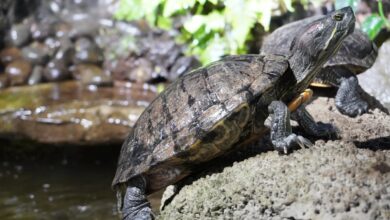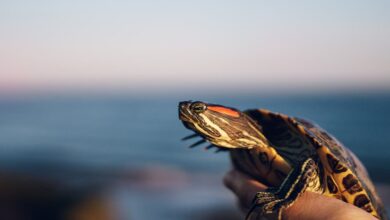
Map turtle diet is the area where the snail-cracking adult females separate from the more generalist males. Tom keeps a single male Mississippi map turtle and answers more “why won’t my female map turtle eat pellets” emails than any other map-related question. This is the species-specific diet companion to our map turtle care guide.
The dimorphism affects feeding
Map turtles are one of the most sexually dimorphic species in the trade. Adult females are 2× the size of males, with broader heads and substantially more powerful jaws — evolved specifically for crushing snails. The diet implications:
- Female maps — molluscivore-leaning. Most efficient eating whole snails. Their jaw musculature requires use; soft-food-only diets cause jaw and beak issues.
- Male maps — generalist. More willing to eat pellets, smaller prey, occasional plant matter.
If you don’t know the sex yet (hatchlings and juveniles), treat them as generalists and watch for the dietary preferences that emerge with maturity.
The age-protein curve
- Hatchlings (0–6 months): 80 % animal protein, 20 % plants. Daily feeding.
- Juveniles (6 months to 2 years): 60–70 % protein, 30–40 % plants. Every other day.
- Sub-adults to adults:
- Females: 50 % protein (substantial snail/mussel component), 50 % plants.
- Males: 60 % protein, 40 % plants.
Animal protein — what to feed
The snail point (especially for females)
Adult female map turtles benefit enormously from whole snails as a regular food. Ramshorn snails, pond snails, apple snails — the female crushes them effortlessly and gets:
- Whole-shell calcium directly.
- Protein nutrition.
- Jaw and beak exercise (prevents beak overgrowth common in soft-food-fed females).
Source: aquarium-shop ramshorns, mail-order land snails, or a self-sustaining snail culture in a separate tank.
Other good protein options
- Earthworms (nightcrawlers, red wrigglers) — well-tolerated by both sexes.
- Aquatic-turtle pellets — baseline, half the protein portion.
- Freeze-dried krill — carotenoid boost, well-eaten.
- Mussel meat and raw shrimp in shell — particularly good for adult females.
- Small feeder fish — rare treat. Avoid goldfish/rosy reds (thiaminase).
- Hard-boiled egg, chopped — rare treat.
Don’t feed
- Raw red meat, processed foods, dairy, dog/cat food.
- Daily live goldfish (thiaminase damage).
Plant matter
Maps are slightly less plant-keen than sliders or cooters but still benefit from the plant portion. They’ll graze on aquatic plants in the tank if available:
- Anacharis — maps eat it, particularly juveniles.
- Duckweed — floats; maps pick at it.
- Water lettuce — palatable.
- Anubias — the durable option attached to bogwood.
- Chopped collard greens, dandelion, mustard greens — offered in the water.
- Hibiscus flowers — floating; some maps love them, others ignore.
Don’t expect maps to be enthusiastic plant-eaters the way cooters are. Offer plants consistently and they’ll graze; some specimens never become enthusiastic plant-eaters but the offering provides micronutrient backup.
Supplements
- Calcium powder (without D3): dust protein meals twice a week. Adult females eating whole snails need less calcium dust because they’re getting calcium from shells; juveniles and males need more.
- Cuttlebone free-choice in the tank.
- Reptile multivitamin with retinol: once a week.
Vitamin A deficiency is common in maps on narrow diets — the multivitamin matters.
Feeding logistics
- Feed in the water.
- Portion size: as much as the turtle eats in 15–20 minutes. Remove leftovers immediately.
- Maps eat slower than sliders — observation feeders, methodical. Don’t mistake their pace for refusal.
- Adult frequency: twice a week for adults, 3-4 times for juveniles, daily hatchlings.
Common map turtle feeding problems
Female refuses pellets, only wants snails
This is the species-typical behaviour, not a problem. Adult female maps in the wild eat ~70 % snails. Provide them; the “refuses pellets” complaint resolves once you accept the species’ natural diet.
Beak overgrowth
Common in females fed soft food only. Without snail-crushing or hard-shelled prey, the beak grows unchecked. Add whole snails or mussel-in-shell; severe overgrowth requires vet beak trim.
Refusal to eat after a setup change
Maps are particularly nervous. Tank moves, new decor, even unfamiliar humans entering the room can shut down feeding for a week or two. Quiet environment + patience.
Sunken or swollen eyes
Vitamin A deficiency. Common in maps on all-bloodworm or all-pellet diets. Vet for injection + dietary overhaul.
Stops eating in autumn
Natural seasonal slowdown in some setups (maps brumate in the wild). If water temperature is still warm and they’re still eating reduced portions, it’s normal. Complete refusal at warm temperatures = vet visit.
Weekly meal plan
Adult male map turtle
- Monday: earthworms + chopped greens.
- Wednesday: pellets + krill + duckweed.
- Friday: small snails + mussel + anacharis.
- Sunday: treat — small piece of shrimp + plants.
Adult female map turtle
- Monday: 3–4 whole snails + chopped greens.
- Wednesday: mussel meat with shell + krill + anacharis.
- Friday: earthworms + small whole snails + chopped collard greens.
- Sunday: apple snail or larger ramshorn + plants.
Calcium dust Wednesday and Friday for males; just Wednesday for females (snail shells cover much of the requirement). Multivitamin once a week.
Outdoor pond maps
Maps thrive in outdoor ponds. The pond environment dramatically simplifies diet:
- Snails breeding in the pond provide hunting opportunities for females.
- Aquatic plants in the pond provide grazing.
- Insect larvae, small fish wandering in — varied protein.
- Natural UVB.
Supplemental feeding 2–3 times a week; the pond does the rest.
Related on Turtle Times
- Map Turtle species overview — natural history.
- Map Turtle Care Guide — tank setup companion.
- Turtle Health & Feeding Guide — all-species hub.
- Vitamin A deficiency — common in maps on narrow diets.
- Painted Turtle Diet Guide — closest comparison.
— Tom, Turtle Times. Map turtle feeding question or photos of your adult female refusing pellets? Contact form — flag “map diet” in the subject.
Got a question we haven’t answered?
The Turtle Times team answers reader questions every week. Drop us a note — Linda covers health, Priya handles softshells and side-necks, Tom takes aquatic species, Marcus covers tortoises, Jenna runs new-owner triage.