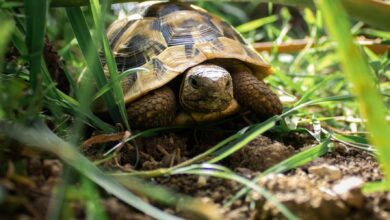
Sulcata diet looks deceptively simple at first glance — grass-eater, feed hay, done. The catches show up after a year or two when keepers realise that hay-only diets cause subtle deficiencies, supermarket veg causes pyramiding, and the cute treats they’ve been offering have shortened the tortoise’s lifespan. Marcus has fed Tank (his 11-year-old Sulcata) on a refined grass-and-weed diet for the past five years and the difference in growth pattern from the early years is dramatic.
This is the diet plan we’d hand to any Sulcata keeper at any age.
The grass-eater reality
Sulcatas evolved on dry African savanna. Their wild diet is essentially what a horse eats:
- ~80 % grasses (fresh in the wet season, dry standing grass and hay-like dry season material).
- ~15 % leafy weeds (the few that grow in the conditions).
- ~5 % miscellaneous — succulents (cactus pads), the occasional fallen fruit, fungal matter.
That “5 % miscellaneous” is the trap. Captive keepers see “tortoises eat fruit” and feed strawberries weekly. Five percent of a Sulcata’s diet is essentially nothing — the equivalent of one or two small fruit pieces per year in the wild. Captive Sulcatas fed weekly fruit get the digestive problems that follow.
The right diet, broken down
Grasses — the bulk
Fresh grass when available, hay when not. Both work; rotation is best:
- Bermuda grass — closest match to African savanna species. Easy to grow in warm climates; available as hay year-round.
- Orchard grass hay — good staple. Higher fibre than timothy.
- Timothy hay — widely available, good staple.
- Meadow hay — mixed grasses, often the best variety option.
- Fresh lawn clippings — only from chemically-untreated lawns, used the same day (cut grass ferments fast).
What NOT to feed as grass:
- Alfalfa hay — too high in protein and calcium. Causes growth problems in juveniles.
- Lush ryegrass — too rich; gives Sulcatas the runs.
- Treated or sprayed lawn clippings — herbicide residue.
Leafy weeds — the supplement
Daily ration of mixed wild weeds:
- Dandelion (leaves and flowers).
- Plantain (the weed).
- Mallow leaves.
- Mulberry leaves.
- Hibiscus leaves and flowers (favourite).
- Sow thistle, chickweed, clover (in moderation; clover is higher protein).
Cactus — underrated
Prickly pear / opuntia cactus pads (thorns removed) are one of the best Sulcata foods we’ve found. Native to overlapping climates, high water content, palatable, well-tolerated. If you live somewhere prickly pear grows, plant it in or near the pen and harvest pads year-round.
What NOT to feed
- Fruit — never as a regular food. Sulcatas evolved on dry savanna; the sugar content causes severe diarrhoea, gut dysbiosis, and over time the pyramided shells that ruin captive specimens.
- Supermarket vegetables (cucumber, courgette, tomato, peppers) — too watery, too sugary, wrong fibre profile.
- Spinach, swiss chard, beet greens — oxalates.
- Peas, beans, pulses — too protein-rich. Kidney damage builds over years.
- Commercial tortoise pellets as a staple — many contain too much protein, too much fruit, too little fibre. Use sparingly or skip entirely.
- Cabbage, broccoli, kale as staples — goitrogen accumulation.
- Meat, dairy, processed foods — not food for tortoises.
Supplements
Sulcatas on outdoor diets often need less supplementation than indoor-housed animals:
- Calcium powder (without D3): dust food twice a week for indoor Sulcatas. Outdoor specimens on natural diet may need less if they have access to cuttlebone and varied forage.
- Cuttlebone free-choice: in the pen at all times. Sulcatas self-regulate calcium intake when given the choice.
- Multivitamin with retinol: once a week.
- Calcium-D3: only for indoor Sulcatas without adequate UVB. Outdoor specimens get D3 from sunlight.
The pyramiding question
Pyramided shell — the scutes raised into peaks — is the visible legacy of bad Sulcata diet. The combination of high-protein diet (alfalfa, peas, beans, dog food) plus low humidity in juveniles produces pyramiding within the first two years that never reverses.
Prevention is the entire strategy:
- Grass and weed staples from week 1.
- Higher humidity (60–70 %) for hatchlings — this is counterintuitive for a desert tortoise but the species lives in burrows that are far more humid than the surface.
- Slow growth — resist the urge to feed for fast growth.
- Daily soaking for hatchlings; weekly for adults.
Established pyramiding is permanent. The shell may grow more smoothly going forward but existing peaks stay.
Water and soaking
Sulcatas drink and soak. Adults need:
- Shallow water dish in the pen, refreshed every other day. They’ll soak as well as drink.
- Weekly bath in 25–28 °C water for 15–20 minutes. Tank loves his.
- Hatchlings: 3–4 soaks per week, 15 minutes each. Critical for proper kidney function and to prevent bladder stones.
Bladder stones from chronic dehydration are a common older-Sulcata issue. Disciplined soaking prevents them.
Hatchling feeding schedule
- Daily feeding for the first year.
- Tiny portions — a hatchling Sulcata is the size of a coin and eats accordingly.
- Soft greens cut small — chopped dandelion leaves, plantain, hibiscus. Hay is too tough for hatchlings.
- Calcium dust every other meal — growing fast, needs consistent calcium.
- Cuttlebone in the enclosure from day one.
Juvenile to adult transition
- Year 1-2: chopped greens daily, gradually introducing hay as the tortoise grows.
- Year 2-5: 70 % grass/hay, 30 % weeds. Every-other-day feeding.
- Adult (5+ years): 80 % grass/hay, 20 % weeds. Feed daily but small portions; Sulcatas graze rather than gorge.
Weekly meal plan for an adult Sulcata
For an outdoor pen with grass and planted weeds, the plan is “let them graze.” Supplement only when natural forage is limited:
- Daily: let the tortoise graze on planted grass + weeds. Add a handful of hay if pasture is thin.
- Monday: chopped mallow + dandelion + small piece of opuntia pad (calcium dust).
- Wednesday: hibiscus leaves and flowers + mulberry leaves (multivitamin).
- Friday: mixed weed harvest + cuttlebone refill (calcium dust).
- Sunday: hay-heavy day if the tortoise has over-grazed planted weeds during the week.
Common Sulcata diet mistakes
- Weekly fruit feeding. Wrecks long-term gut health.
- Lettuce-and-cucumber salad approach. Too watery, too low-fibre. Sulcatas need fibre.
- Commercial tortoise pellets as the main food. Wrong nutrient profile for the species.
- Alfalfa hay confusion. Alfalfa ≠ grass hay. Don’t use it as a main food.
- Iceberg lettuce as a base. No nutrition.
- Treating the tortoise with human food. They’ll eat it; it hurts them.
- Not providing cuttlebone. The self-regulation is real.
- Skipping soaks. Bladder stones build over years.
Related on Turtle Times
- Sulcata Tortoise Care Guide — full housing and species overview.
- Mediterranean Tortoise Diet — the closely-related framework for smaller Testudo species.
- Turtle Health & Feeding Guide — all-species diet hub.
- Fruit-feeding guide — covers why Sulcatas almost never get fruit.
- Turtle & Tortoise Care Index — master husbandry hub.
— Marcus, Turtle Times. Sulcata feeding question or photos of a pyramided shell you’re worried about? Contact form — flag “Sulcata diet” in the subject.
Got a question we haven’t answered?
The Turtle Times team answers reader questions every week. Drop us a note — Linda covers health, Priya handles softshells and side-necks, Tom takes aquatic species, Marcus covers tortoises, Jenna runs new-owner triage.