Basking Area Setup: Complete Guide for Aquatic Turtles

The basking area is the single most-important part of an aquatic turtle setup that new keepers get wrong. Tom’s seen thousands of slider tanks over twelve years and the same four mistakes show up over and over: basking spot too cold, no UVB, bulb the wrong distance from the platform, and a platform too small for the turtle to actually use. This guide is the long-form “how to set up basking properly” we wish more new keepers read first.
Why basking matters — the biology
Aquatic turtles are ectotherms. They don’t generate body heat internally; they raise their temperature by exposing themselves to a heat source. In the wild they bask on logs, rocks, or the bank of a pond for several hours a day. The basking session does three things biologically:
- Raises core body temperature — required to digest food properly. A turtle that can’t reach basking temperature won’t metabolise its meals and will lose weight.
- Triggers vitamin D3 synthesis — UVB rays from sunlight (or a UVB tube) hit the skin and let the turtle convert provitamin D to D3, which is needed to absorb dietary calcium.
- Dries the shell and skin — prevents fungal growth and shell rot. A turtle that can’t fully dry off develops shell problems within months.
Skip any of those three and you get one of the predictable health problems: metabolic bone disease (no UVB), shell rot (no drying), or failure to thrive (no heat). All preventable with a basking setup that’s actually set up right.
The platform — size, shape, position
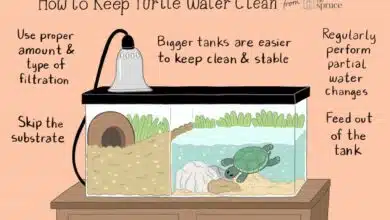
The basking platform has to get the turtle fully out of the water, with the shell completely above the waterline. A partially-submerged platform isn’t enough — the shell needs to dry.
Size: on the short axis, the platform should be at least 1.5× the turtle’s shell length. So an adult slider with a 25 cm shell needs a platform at least 38 cm wide. Bigger is always better; multiple turtles need proportionally more.
Shape: a flat top with a ramp or slope leading up from the water. The slope shouldn’t be steeper than 45° or smaller turtles struggle to climb. Texture matters — smooth glass or plastic is hard to grip; cork-bark or pebble-textured surfaces work much better.
Position: at one end of the tank, not the middle. The turtle wants to look around from the basking spot, and an end position gives 270° visibility. Position it directly under the basking lamp.
Heat — what temperature, what wattage
Target temperature at the platform surface: 32–35 °C (90–95 °F) for most aquatic species. Slightly cooler for musks and maps (28–32 °C). Slightly warmer is fine; below 30 °C and the turtle won’t bask effectively.
The way to measure this is a digital probe thermometer placed on the platform surface, not the strip thermometer that came with the tank. Strip thermometers measure ambient air temperature and lie by 5–10 °C.
Wattage and distance: the right combination of bulb wattage and bulb-to-platform distance gives the target temperature. There’s no single “right” wattage — it depends on your specific setup. Rough starting points:
- Hatchling tank, small platform, 15 cm bulb distance: 50 W incandescent or halogen flood.
- Juvenile / small adult, 20 cm distance: 75 W flood.
- Large adult, 25–30 cm distance: 100 W flood. Bigger platforms (for cooters, large female sliders) might need 150 W or two 75 W bulbs.
Adjust by measuring the temperature with the probe and moving the bulb closer or further until you hit target. Don’t guess.
UVB — the make-or-break
This is where the most setups fail. The biology is simple: without proper UVB, the turtle can’t synthesise vitamin D3, can’t metabolise calcium, and develops metabolic bone disease (soft shell, deformed limbs, rubbery jaw). Damage from established MBD is largely permanent.
Use a real reptile-grade UVB tube. Specifically:
- Arcadia 10.0 T5 HO, or
- Zoo Med ReptiSun 10.0 T5 HO, or
- An equivalent linear fluorescent tube marketed for reptiles.
The 10.0 figure refers to UVB output. Aquatic turtles want the high-output (10.0) tubes. For tortoises a 5.0 or 6.0 tube is often enough. Compact CFL UVB bulbs (the screw-in type) are not adequate — they produce far less UVB and the output drops off so fast that they’re effectively useless past 15 cm distance.
Distance from platform: the tube needs to be within 25–30 cm of the basking platform. UVB output falls off rapidly with distance; a tube 50 cm above the platform is producing roughly a quarter of the useful UVB.
No glass or solid plastic between tube and turtle. Mesh is fine. Glass blocks UVB — this is why sunlight through a closed window doesn’t work (see our reader Q&A on UVB through glass).
Replace every 12 months. The tube continues to emit visible light long after UVB output has dropped below useful levels. Write the install date on the tube with a permanent marker and replace annually whether or not it still looks bright.
Photoperiod
Aquatic turtles want 10–12 hours of light per day. The simplest setup is a timer running both the basking lamp and the UVB tube together — 10 hours on, 14 off. Adjusting seasonally (longer in summer, shorter in winter) more closely matches wild conditions but isn’t essential.
Don’t leave the lights on 24/7. Turtles need a dark period to rest, and a 24/7 photoperiod is one of the causes of long-term stress.
Common basking-setup mistakes
1. The platform that’s too small
An adult turtle that can’t fully fit on the platform won’t use it. We see this constantly — a 20 cm slider in a tank with a 15 cm-square platform. Result: the turtle stops basking, doesn’t dry, develops shell rot or refuses to thermoregulate.
2. The basking spot under 30 °C
Common with under-wattage bulbs, or with the lamp too far above the platform. The turtle hauls out, finds the spot lukewarm, and goes back into the water. Eventually they stop trying.
3. UVB tube replaced years ago
Bulb still lights up; output dropped below useful levels months ago. The single most common cause of metabolic bone disease in captive turtles.
4. UVB tube too far from platform
Often happens when the tube is mounted on top of a tall tank where the platform is 50 cm below it. Useful UVB at the platform is essentially zero. Fix: lower the tube, or raise the platform.
5. Glass lid between bulb and water
The decorative glass top blocks UVB. Use mesh screen tops instead.
6. Compact CFL UVB “eco-bulbs”
Sold cheap, marketed as reptile UVB. Output is a fraction of a proper linear tube and drops off rapidly. Not adequate. Pay the extra for a real T5 HO tube.
7. Wet basking surface
If the platform is partly submerged or constantly splashed, the turtle never dries. Defeats the purpose. Position the platform fully above the waterline.
Outdoor basking — the gold standard
If you live somewhere that doesn’t freeze year-round and you have outdoor space, an outdoor enclosure (pond + sloping basking log + predator-proof mesh roof) provides better basking than any indoor setup can match. Natural sunlight contains the full UVB spectrum the turtle evolved with, and varying weather provides natural thermal cycling.
Outdoor keepers don’t need a basking lamp during the warm months (sunlight does it) and don’t need a UVB tube (sunlight does that too). The energy and bulb-replacement savings make outdoor enclosures cheaper to run long-term than indoor setups.
Equipment summary — the basking starter kit
For a standard indoor adult-slider setup:
- Floating or fixed platform sized appropriately for the turtle.
- Basking flood lamp 75–100 W in a ceramic socket fixture.
- Reptile-grade T5 HO UVB tube (Arcadia 10.0 or Zoo Med ReptiSun 10.0) plus the matching fixture.
- Digital probe thermometer for measuring platform surface temperature.
- Timer to run both lights on a 10–12 hour cycle.
- Mesh screen top (not glass).
Total cost typically US$80–150 depending on brand and tank size. Cheap compared with the cost of treating MBD or shell rot in the years that follow.
Related on Turtle Times
- Care Sheets & Information — full enclosure hub.
- Turtle & Tortoise Care Index — the master husbandry hub.
- Turtle Health & Feeding Guide — the medical companion (MBD is covered here).
- UVB through glass — reader Q&A — the physics in plain language.
- Red-eared slider tank setup — the species-specific deep-dive.
— Tom, Turtle Times. Got photos of your basking setup or a temperature problem you can’t solve? The contact form reaches my inbox — flag “basking” in the subject.
Got a question we haven’t answered?
The Turtle Times team answers reader questions every week. Drop us a note — Linda covers health, Priya handles softshells and side-necks, Tom takes aquatic species, Marcus covers tortoises, Jenna runs new-owner triage.