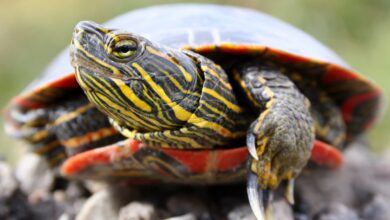
The Three-Toed box turtle (Terrapene mexicana triunguis) is the second-most-kept North American box turtle in the pet trade after the Eastern. Named for the three claws on its hind feet (most other box turtles have four), the subspecies has a distinct olive-grey colouration and slightly different husbandry needs from its Eastern cousin. Linda answered enough “wait, is this an Eastern or a Three-Toed” emails to make this dedicated guide worthwhile.
Species identification
Three-Toed box turtles are native to the south-central United States — Missouri, Arkansas, Louisiana, Oklahoma, Texas, parts of Kansas. The range overlaps with Eastern boxes at the eastern edges, which is why hybrid specimens sometimes appear in the wild and pet trade.
Identifying features:
- Three claws on each hind foot — the diagnostic feature. Easterns have four.
- Olive-grey to olive-tan carapace — less patterned than Easterns.
- Yellow or orange head markings in mature males, particularly bright in the breeding season.
- Adult size: 11–15 cm shell length, slightly smaller on average than Easterns.
If your turtle has four claws on each hind foot, it’s an Eastern (or one of the other four-clawed subspecies like Ornate). If three, almost certainly a Three-Toed.
Climate match — the subspecies-specific point
Three-Toed box turtles come from a slightly warmer, more humid native range than Easterns. The practical implications for captive husbandry:
- Higher humidity preferred — 70–80 % versus the 60–75 % Easterns tolerate. Daily misting or a high-humidity hide is important.
- Slightly higher minimum temperatures — cool-end ambient should stay above 20 °C indoors; outdoor pen night lows below 15 °C trigger brumation behaviour earlier than Easterns.
- Shorter natural brumation — 8–12 weeks rather than the 10–14 typical for Easterns.
Otherwise, husbandry mirrors the Eastern box turtle setup. See our Eastern Box Turtle guide for full housing requirements.
Outdoor pen setup
Three-Toeds thrive outdoors in warm-temperate climates from spring through autumn. The pen specifics:
- Footprint: 4×3 m minimum for a single adult.
- Walls: 30 cm above ground, buried 15 cm.
- Substrate: soil with deep leaf litter; lean toward the humid side (a damper corner). Cypress mulch under leaf litter works well.
- Plants: low shrubs, hostas, ferns. Three-Toeds appreciate denser plant cover than Easterns.
- Multiple hides: at least three, in different microclimates — cool/humid, warm/damp, dry.
- Shallow soaking dish: refreshed daily. Three-Toeds soak more readily than Easterns.
- Shade: 70 % of pen shaded by canopy or shrubs. They’re forest-edge animals; full-sun exposure stresses them.
- Predator-proof: wire mesh roof, perimeter buried.
Indoor enclosure (winter or hatchlings)
Same tortoise-table layout as Eastern boxes:
- Floor area 200×100 cm adults; 120×60 cm hatchlings.
- Cypress mulch or coco coir 5 cm deep, lightly damp throughout, with extra-damp humid hide corner.
- Basking spot 32–35 °C; cool end 22–24 °C (slightly warmer than Eastern setups).
- UVB tube replaced annually.
- Daily misting maintains target humidity.
- Photoperiod 12 hours summer, 10 winter.
Diet
Three-Toed box turtles share the omnivorous, fruit-positive diet of Eastern boxes. The proportions are essentially identical:
- ~50 % animal protein — earthworms, snails, slugs, gut-loaded insects.
- ~30 % fruit and soft vegetation.
- ~20 % leafy greens.
See our Box Turtle Diet Guide for the full framework.
One feeding observation worth noting: Three-Toeds tend to take mushrooms more readily than Easterns — their native habitat includes more fungal-rich forest floor. Button mushrooms, oyster mushrooms, and shiitake all work as occasional foods.
Brumation
Three-Toed box turtles brumate slightly later in autumn and emerge slightly earlier in spring than Easterns. Captive specimens follow the standard brumation protocol (see our brumation guide), with:
- 10–12 weeks total brumation (vs 12–14 for Easterns).
- Slightly higher target temperature acceptable: 6–10 °C rather than 4–8 °C.
- Slightly warmer pre-brumation cooling phase.
Pre-brumation vet check non-negotiable, as with all temperate species.
Health red flags
Same as Eastern box turtles — vitamin A deficiency (swollen eyes), respiratory infections, shell rot from wet conditions without dry-out opportunity. Three-Toed-specific:
- Dehydration faster than Easterns — the higher-humidity preference means they suffer more rapidly in dry indoor air. Daily misting matters.
- Lethargy in cool conditions — Three-Toeds drop activity at temperatures Easterns handle fine. Maintain warmer minimum temperatures indoors.
Full triage in Turtle Health & Feeding Guide.
Behaviour
Calmer than Easterns in our experience, possibly because the higher-humidity setup reduces stress. Same observation-pet philosophy — don’t handle for fun, do provide observation access. Active foragers in cool morning and evening conditions; rest through midday heat.
Single-keeping or pairs. Mixed-sex pairs breed reliably given seasonal triggers.
Legal status
Three-Toed box turtles are protected in most range states with varying restrictions:
- Missouri, Texas, Arkansas, Louisiana, Oklahoma all regulate captive keeping at various levels.
- Some states permit captive-bred ownership with state-issued paperwork.
- Federal CITES Appendix II for international trade.
Check your state. Don’t take wild specimens home — the species shows strong site fidelity and removing one from its home range usually results in stress decline.
Buying advice
- Captive-bred only. Hatchling prices US$100–300.
- Verify subspecies. Three-Toeds and Easterns are sometimes sold interchangeably. The three-claw test is definitive.
- Hybrid awareness. Wild and captive-bred Eastern×Three-Toed hybrids exist; they’re fertile and viable but worth knowing if you’re acquiring breeding stock.
- Adoption. Box turtle rescues across the central US have Three-Toeds available.
Related on Turtle Times
- Eastern Box Turtle Care Guide — the closely-related subspecies with full husbandry framework.
- Box Turtle species overview — covers all four common subspecies.
- Box Turtle Diet Guide — full feeding companion.
- Brumation Guide — protocol for safe winter rest.
- Turtle Health & Feeding Guide — medical companion.
— Linda, Turtle Times. Three-Toed box turtle question or trying to identify which subspecies you have? Contact form — flag “Three-Toed” in the subject.
Got a question we haven’t answered?
The Turtle Times team answers reader questions every week. Drop us a note — Linda covers health, Priya handles softshells and side-necks, Tom takes aquatic species, Marcus covers tortoises, Jenna runs new-owner triage.